I posted a new article on Psychology Today this week, all about brain lateralization—whether the brain can be “handed”.
The main point of the article was to argue that the notion of individual people being left-brained or right-brained, and that determining their personality type, is a myth.
But, it’s a myth built on something real.
Despite being symmetrical, the two halves of brains don’t just operate as two parallel units, there is uneven distribution of tasks and allocation of resources across the two sides.
This distribution of tasks is not absolute, though. It is a bias, not a complete segregation. A task like language processing shows more activity in the left side than the right, but there is still lots of crosstalk and communication between the hemispheres.
When it comes to limerence, lateralization is most relevant for the reward and bonding systems, given the underlying neuroscience that explains the experience of person addiction.
I talked about reward in the Psychology Today article, but didn’t touch on bonding. That’s really interesting too, because there’s a body of work that suggests that lateralization depends on a crucial period in the early life of newborns, when the interaction between baby and mother is shaping a huge amount of brain development.
Cradling instincts
Cross-culturally, both men and women have a bias towards left-cradling of babies.
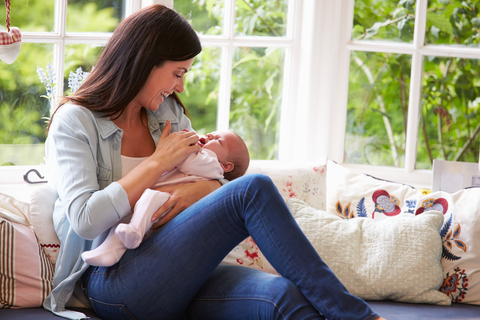
This means the baby is orientated to see more with the left eye and hear more with the left ear, and that promotes development of the structures in the right hemisphere of the brain (because each hemisphere regulates function in the opposite side of the body).
Because emotional development is dependent on the baby sensing and learning the mother’s facial expressions, and using them to synchronise levels of arousal, it’s inevitable that those functions of the brain will develop most quickly and efficiently in the right hemisphere. There’ll be a bias towards using the right-hand structures for emotional processing.
You can really go down a rabbit hole of speculation here.
Do we have a left-cradling bias because most of us are right-handed (and instinctively leave our dominant hand free), or are most of us right-handed because we have been left-cradled?
Is the left-cradling bias conserved because it’s useful or because it reproduces itself?
Is the right hemisphere bias for emotion useful, and therefore babies that were left-cradled survived and reproduced more successfully, meaning we all inherited the trait?
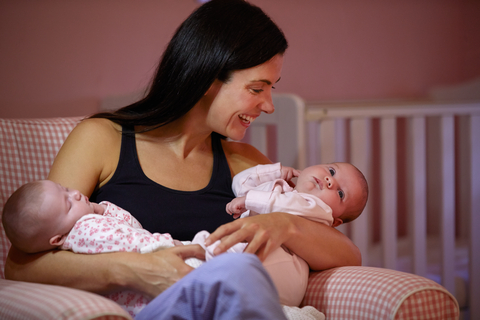
Regardless of all these questions about how the bias developed, it’s a great example of how a weird little behavioural quirk that most of us would never notice can have really consequential outcomes that last into adulthood.
Don’t despair
Just in case anyone is reading this and thinking “oh no, I cradled my babies on the right!” or “oh no, my mother didn’t cradle me correctly, I’m doomed to a life of bonding frustrations!” don’t despair.
Brain lateralization is not an unalterable feature, nor an essential feature. Most people with atypical laterlization patterns have happy and successful lives. People who suffer damage to one side of the brain can learn to use the opposite side instead.
Brains can adapt and re-organise their activity to compensate for deficits or damage.
We can learn to overcome attachment problems. We can learn to better regulate our emotions. We can learn new ways of relating to others that improves our future relationships.
Lateralization isn’t fate.
It’s just another interesting aspect of the brain that shows how complex the interplay between our genes, environment, family and childhood experiences really is in shaping our personalities and temperaments.
Humans are complicated.
I actually have twins and I didn’t hold them the way depicted in the photo.
I wonder if that’s why they are the way they are? Too late now, they just turned 32.